
Tsovinar Hovhannisyan, Armenian Society for the Protection of Birds (ASPB) http://www.aspbirds.org
While the RA Ministry of Nature Protection defines the dates for legal hunting activity, poaching and illegal catch have been picking up throughout the country, wiping out species of birds that have been common in Armenia in the recent past.
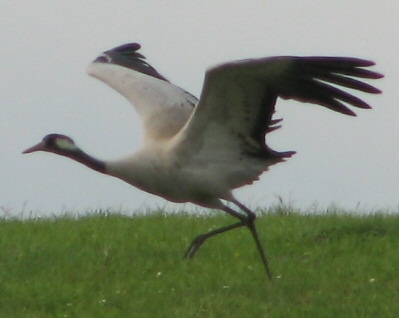
Illegal hunting threatens even those species that have so far managed to ignore the plight of endangered species. Unfortunately, the menace didn’t miss even a small group of cranes that continued to breed in the north of Armenia: wetlands in close proximity to Stepanavan and Tashir towns, and the boggy and waterlogged grasslands near Lake Arpi. These small lakes, wetland patches and waterlogged flood lands are very important breeding grounds for most waterbird species, including the tiny breeding population of common cranes.
Traditionally, the Common crane (Grus grus lilfordi, Sharpe 1894) has been treated by ornithologists as a breeding species in the Transcaucasus. At the turn of the 19th and the 20th centuries breeding cranes have been fairly common in the Armenian Highland (Javakheti Plateau). Population was estimated at several hundred individuals. In 2007 Armenian scientists have attended a scientific conference “Cranes of Palearctic: Biology and Conservation“ in Russia. It was reported by Mamikon Ghasabyan at the conference that cranes are still known to breed in Armenia. This news has kindled a great interest of the conference because main breeding grounds of the common crane are far in Asia and Europe.
Following up the interest aroused, a Russian ornithologist V.Y. Ilyashenko has visited Armenia in May this year and studied the small colony of cranes breeding in the north of Armenia together with a scientist from the Armenian Society for the Protection of Birds (ASPB). It has come to knowledge that wetlands near Lake Arpi appear to be the sole breeding ground for cranes in Armenia, because the cane has disappeared from the wetland areas of Stepanavan, where it bred, due to illegal hunting and uncontrolled human disturbance.
Additionally, the research has shown that the birds being studied had clear morphological distinctions from that of Grus grus lilfordi, Sharpe. This is an important news both for science and conservation. While the taxonomic status of the transcaucasian cranes is being assessed, a terrible thing happened – one of the cranes of the new form has been killed.
As a result of illegal hunting activity, one of the cranes was killed near shorelines of Lake Arpi in Shirak Marz, which has clearly become the reason for their premature departure from Armenia. Normally cranes leave Armenia in late October - early November. So let us hope that with the arrival of spring, the cranes will arrive too. Otherwise, the last surviving population of breeding cranes will be lost from Armenia forever.
December 12, 2008